The Canons of the Greek Orthodox Church do not forbid the use of musical instruments in the Church. However, by tradition, musical instruments are not used. If a musical instrument is used, the instrument of choice is the organ and other instruments may be used with proper permission and adherence to specific guidelines according to the archdiocese. The use of instruments should support the singing and enhance the worship experience without overshadowing the vocal elements. To sum, Canon Law allows for a variety of instruments in the liturgy, provided they are used appropriately.
In learning the Chromatic Lyre Harp, I became acquainted with the fact that one could adjust the tone of the relative sharp/flat string to what is called, a microtone of various degrees. An organ cannot do that – the relative sharp/flat on an organ is always a semitone, it cannot be tuned any finer – where a Lyre Harp can. Since Byzantine music is microtonal, the Chromatic Lyre harp is the perfect practice companion. One may not want to use the lyre harp in church, but it can help the chanter learn the proper sound of the microtone. That said, a series of Byzantine Church Music will be played using the Chromatic Lyre Harp on this website. The first offering of this music is The 23rd (22nd) Psalm which may be found at this link: https://www.youtube.com/playlist?list=PL98bTeh0dciwET1eSRKDk81wfJt3YwrgN Additional Byzantine music played on a Chromatic Lyre Harp will be added as completed.
The below images show how the Chanters in the Greek Orthodox Archdiocese in America transcribe the Byzantine notation of the church music (first image) into Western Music Notation (second image) so singers who read only Western Music Notation may chant Byzantine Style in both Greek and English.
Source: Greek Orthodox Archdiocese Digital Chant Stand: https://dcs.goarch.org/goa/dcs/dcs.html
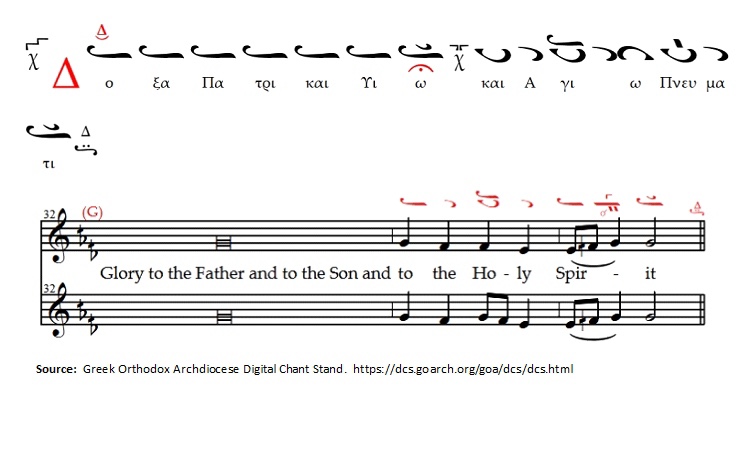
In the above Western music notation, you will see that each flat in the key signature has a slash through the stem. That indicates a quarter-tone flat. This notation is used in microtonal music – which is what Byzantine music is – microtonal. When playing the Lyre, one can tune the respective strings for the sharps/flats 1/4 tone to accomplish this. This makes the Lyre an ideal instrument to play Byzantine music on as compared to other instruments which can only produce a semi-tone.
Function of Quarter-Tone Flat*
- Pitch Adjustment: It lowers the pitch of a note by one quarter tone.
- Microtonal Music: This symbol is essential for representing pitches that are smaller than a semitone, allowing for more nuanced musical expression.
Understanding this notation is crucial for performers working with music that explores pitches beyond the standard Western tuning system.
*Source: https://en.wikipedia.org/wiki/List_of_musical_symbols
To learn to play the Lyre Harp and Read Western Music notation, the following teachers are recommended:
Sharon Brownell of Learning the Lyre Harp https://www.patreon.com/c/learningthelyreharp/posts
Catherine Guilbeau of Enfolded Heart https://www.patreon.com/cw/enfoldedheartmusic
If you are interested in really learning the art of Byzantine Chant, the following link provides authentic Byzantine Chant instruction in the tradition of the (Christian Orthodox) Ecumenical Patriarchate of Constantinople. Michael Tsiappoutas, PhD is providing this valuable training free of charge in English to help those who want to learn but one does need to have the ability to read Greek to chant the lyrics of the music . The link follows: https://www.patriarchalpsaltophiles.org The book to accompany this instruction is entitled, Psaltic Method. A Greek Byzantine Liturgy Chant Primer by Michael Tsiappoutas, PhD. It is free to download at this link: https://www.patriarchalpsaltophiles.org/book If you wish to purchase a physical book, it is available on Amazon. Lessons are free on YouTube: https://www.patriarchalpsaltophiles.org/lessons

